Sunday, January 24, 2016

Kenneth Morris's "Shon ap Shenkin"

It took me years to understand some references in one of Kenneth Morris's letters to Ella Young.  On 28 February 1928, Morris sent Young a copy of his short story collection, The Secret Mountain and Other Tales (London: Faber & Gwyer, 1926).  It includes Morris's short tale "Sion ap Siencyn," originally published in the July 1921 issue of The Raja-Yoga Messenger.  (It also appeared in my volume, The Dragon Path: Collected Tales of Kenneth Morris, published in 1995.) What Morris wrote in a letter to Ella Young accompanying his book is as follows:

In that book you will find a story called Sion ap Siencyn (Shawn ap Shenkin) which is my one short Welsh fairy story—& a genuine Welsh folk tale too, though the telling is mine of course. . . . Now if the editor of the collection you speak of would like to put that tale in—and you will tell me—I will soon make or get made a typed copy thereof to send you. . . . Anyhow, the improbable event of their wishing to take that story (which is a good one with me) gives me a kind of opportunity to send you the book which I hope won't displease you after Fates.
The 1928 cover

Some months later, in another letter to Miss Young dated 30 July 1928, Morris adds cryptically: "Thanks for showing me Miss Stern's letter referring to Sion ap Siencyn."

I'm pleased finally to be able to say that this refers to the inclusion of Morris's story as "Shon ap Shenkin" in the fourth volume On the Highroad to Adventure (1928) in a series of eight books collecting material for children under the overall title Book Trails.  The series was published by Shepard and Lawrence of Chicago.No editors are listed but an acknowledgement credits Renée B. Stern as editor (with O.Muiriel [sic] Fuller as associate editor), and thanks Ella Young for aiding in the selection of folklore and fairy-tale material. Morris's story appears on pages 247 through 251, and has a (hideous) colored illustration for it signed Keith Ward.  
The 1946 cover

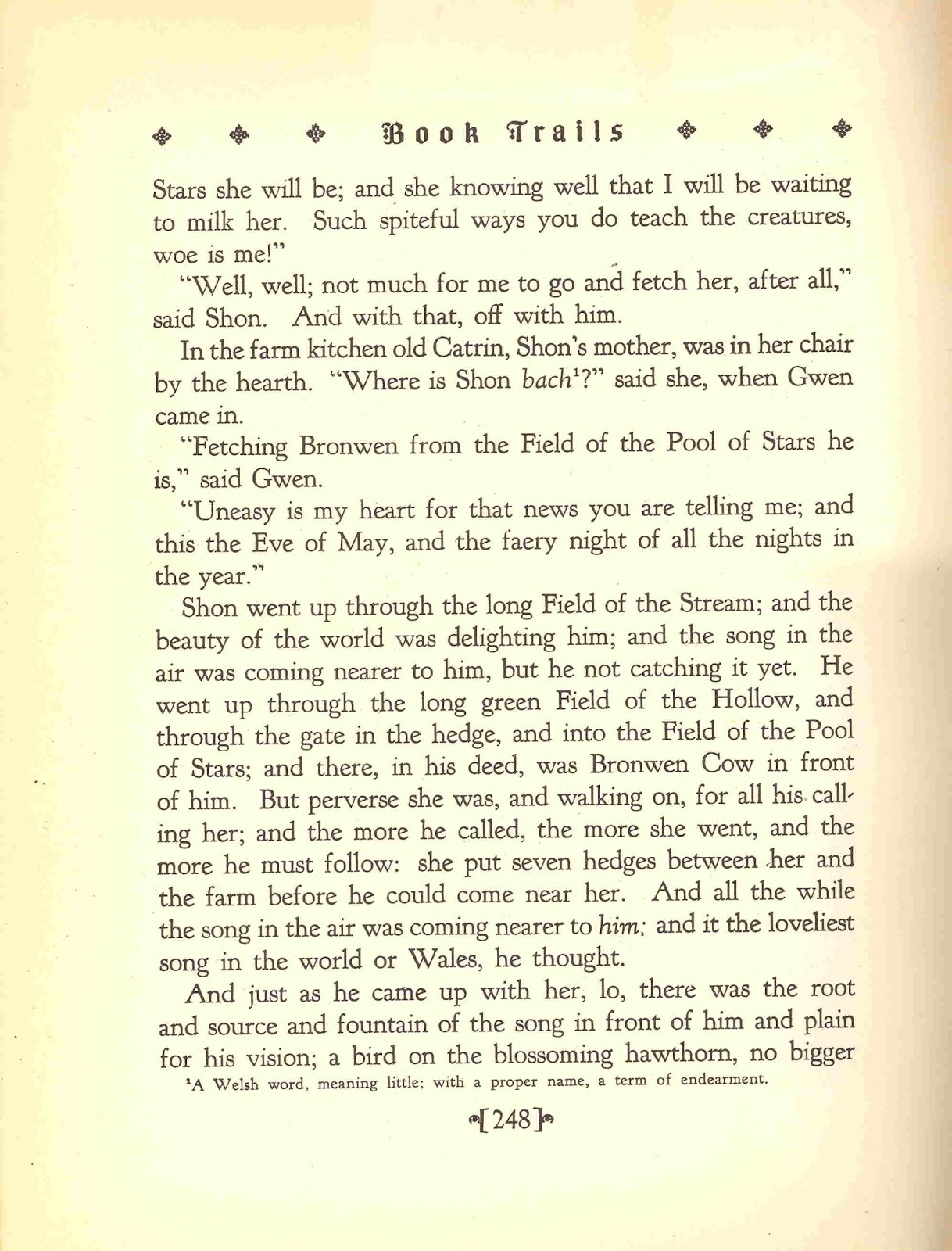
The Book Trails series was reprinted in 1946 by Child Development Inc. Publishers of Chicago. And this time On the Highroad to Adventure comprises volumes 7 and  8, with the same pagination for Morris's story in volume 8.  It seems clear that Morris retyped the story for Miss Stern, as the text is slightly different from that which appears in all other publications.  Here follows scans of the five pages.  It's a fine tale, typical of Morris's style, if shorter than most of his tales.  


Monday, January 18, 2016

A Place I’d Like to Window-Shop


This photograph of a window display from the September 1898 issue of The Bookman makes me want to time travel.  I can see The Lark advertised at the top left corner, and an illustration of William Sharp (Fiona Macleod) below it. I wish the other items were more clearly visible. The accompanying notices are a bit sneering with regard to decadent literature, and I really don’t believe that Mr. Doxey viewed decadent literature as a huge joke, though the Bookman writer clearly does.  And I wish the decadent magazines from nearly every state were more accessible, though there is a very good account of many of them in Kirsten MacLeod’s American Little Magazines of the 1890s: A Revolution in Print (2013), based on an exhibition at the Grolier Club in New York.


Mr. William Doxey of San Francisco has in preparation for publication in the autumn a series of folk-lore stories of the South of France, entitled Tales of Languedoc, by Professor Samuel J. Brün, of Stanford University, and a book of short stories by Emma Frances Dawson, the title of which will probably be An Itinerant House. Both books will be illustrated by Mr. Ernest Peixotto, whose work in the Lark we have already have occasion to commend. Miss Dawson’s stories have a strong local colour, and Mr. Ambrose Bierce says of her, that “in all the essential attributes of literary competence she is head and shoulders above any writer on the coast;” which certainly piques our curiosity and assures prompt attention for the book when it appears.

Our readers will remember that in our July number we described a Stevenson window in Mr. Doxey’s book-shop in Market Street, San Francisco. Mr. Doxey, who is a man of enterprise and ideas, has succeeded this with an exhibition in his window of decadent literature, a picture of which appears herewith. As an admirer of Stevenson Mr. Doxey is, of course, no disciple of decadence, and we treat the whole matter as the nature as a huge joke. Still it is no joke, but a serious sign of the times, for Mr. Doxey has brought home to the man in the street, as nobody else has done, the existence of decay, or what passes for decay in literature or art. He has arrayed in that weird window of his all sorts and conditions of modern writers and artists. He has recruited his ‘cohorts of the damned.’ as Kipling has it, from nearly every country of Europe. By far the most interesting aspect of the question is the number of fin de siècle journals that have a sprung up during recent years. They began with The Yellow Book, which sprang into life April 12th, 1894, the first imitation of which in American was the Chap-Book, published by Messrs. Stone and Kimball, and which appeared just one month later than the Bodley Head quarterly. Since then nearly every State has had its decadent periodical. Far and away the most amusing, the most curious of the whole series, is the Lark. It was brought into existence in May of last year. It is the reductio ad absurdum of decadence, and is a good-humored burlesque of the whole movement. It is a sixteen-page, ten-cent monthly, printed on a kind of paper more useful for holding tea than type. It ridicules the eccentricities of typography by printing prose as if it were verse. Its illustrations are exactly like the primitive woodcuts of three hundred years ago, and it cultivates the gentle art of nonsense-verse to perfection. Mr. John Lane, we believe, is to publish an English edition of the Chap-Book. Why no, we would suggest to Mr. Doxey, find an English publisher for the Lark?

Friday, January 15, 2016

A. A. Wyn and Ace Books

A.A. Wyn (1898-1967) founded Ace Books in 1952, having worked for many years previously in the pulps and the comics under the business name of Ace Magazines.  Generally he was known for paying authors as little as possible. But one author, David McDaniel (1939-1977), found a special way to protest. He wrote for Ace Books some original Man from U.N.C.L.E. novels, based on the television series, including the 8th book in the series, The Monster Wheel (1967). 

What McDaniel did was design the chapter titles so that if you read down just the initial letters from chapter 1 through chapter 16 (ignoring section titles), it reads:  AAWY NISA TIGH TWAD or "A.A. Wyn is a tightwad." And here it is for all posterity to see. Thus is A.A. Wyn immortalized.


Tuesday, January 12, 2016

Lovecraft Left His Mark

H.P. Lovecraft was heavily involved with amateur journalism in the United Amateur Press Association, and served as Official Editor of The United Amateur at various times from 1917 through 1925. Some of his close friends were involved too.  So when I recently saw the May 1926 issue of The United Amateur, it wasn't surprising to see evidence of Lovecraft's influence, even though Lovecraft was not then the editor:  three poems by Clark Ashton Smith (one a translation from Baudelaire); two poems by Samuel Loveman; two poems by Frank Belknap Long; and one poem by Wilfred B. Talman. There is a short piece of weird prose, "The Ultimate" by B. Coursin Black.  At first I wondered whether "B. Coursin Black" might be a pseudonym, but surprisingly it isn't. 

Biddle Coursin Black  was born in McKeesport, Pennsylvania, in 1900, and died in Phoenix, Arizona, in 1984.  He was the fourth and final child of Robert Jere Black (1855-1918) and his wife, the former Mildred Blanche Coursin (1868-1918), a daughter of Benjamin Biddle Coursin (1837-1913).

B. Coursin Black moved around quite a bit, living in Santa Monica, California, then Grand Rapids, Michigan in the 1930s and early 40s, and in Jamestown, New York, in the later 1940s and 50s.  In his entry in Who Was Who among North American Authors, he classified himself as a critic and writer, who had contributed "articles of varied interests to numerous fiction and trade publications, and newspapers, freelance and contract." Only one story by Black seems to have made it into book form, "Spring Sprites" collected in Aquarian Age Stories for Children Volume 1, published by the Rosicrucian Fellowship in 1951. Black never married.  Here follows his vignette from The United Amateur for May 1926. It seems very likely that Lovecraft read it, alongside of the writings of four close friends.


The Ultimate

by B. Coursin Black


The cabin crouched low on the shadowed hill, where creeping hemlocks prisoned it, their gaunt branches clawing out till they almost grasped the shaggy roof, like convict hands that slyly reach to throttle the passing jailer. A grey rail edged the narrow porch, with flower-boxes nestling in the corners—boxes brimming with flowers that were red, blood-red. The huge door in the center was shut and bolted with a cross-bar. But the lady who rocked in the chair in the porch-corner did not seem to sense the sinister silence, the incongruity of the blood-flowers on the threshold of abandoned desolation. She was smiling as she rocked, her contented eyes lazily following the antics of a yellow butterfly frisking among the foliage.

I watched it all with quick-breathed fear. I could not speak. I could not move to warn the lady. . . . . I, who knew the unhallowed mystery of the gruesome place, who knew of the THING inside . . . . . the un-nameable, unthinkable THING that had never been seen by human eyes . . . fear, like a black, suffocating curtain, covered me, and a pall as dense as a burial shroud weighed me down as a living force.—Through it came faint, ghoulish laughter, like witch-water tinkling in the dell, laughter that mocked my utter helplessness. Suddenly the butterfly winged swiftly away, disappearing in the gloom of the brooding trees, and then . . . .

A small air-window, next the roof, opened slowly, the dust of dead days settling thick to the floor, the hinges silent, as the frame widened outward, propelled by some unseen force from the black void within. Then a CLAW . . .  white and long and bony, with beast-fingers opening and closing, stretched out from that grisly room inside, and moved out and down, with never a sound, toward the figure beneath . . . further and further, clawing and clutching . . .

I shrieked and all went black before me . . . . . . . . . . .


Saturday, January 9, 2016

No, that's not Eleanor M. Ingram!

A few months ago Villianous Press reissued Eleanor M. Ingram's horror novel The Thing from the Lake, originally published in 1921 several months after the author's death.  Villanous Press gave the book a nice cover, and there appears to be a photograph of the author on the rear cover. Here are the front and back covers:


The problem is, the photograph is not of Eleanor M. Ingram, but of one Eleanor M. Moore (1875-1949), an Australian peace activist. The photo appears as the frontispiece to her book, The Quest for Peace as I Have Known It in Australia (1949).


Below is the real Eleanor M. Ingram, author of The Thing from the Lake, along with a photo of her father, lawyer John W. Ingram (1861-1937), with whom Eleanor shows a decided family resemblance.

Eleanor Marie Ingram


John W. Ingram


As we know, once an error gets on the internet it proliferates beyond the capacity for correction.  But I post a correction here in the hope of forestalling the proliferation somewhat. We'll see if it has any effect. 


Thursday, January 7, 2016

T.M. Wright in THE BRUTARIAN

Brutarian (sometimes Brutarian Quarterly) was an odd kind of mixed-and-changing punk-goth-film-literary magazine that ran for around 55 issues from 1991 through about 2010.  Besides the music and film coverage, there were occasional interviews with fantasy, science-fiction and horror writers, plus fiction as well. 

I first looked at Brutarian because it published some new stories by my friend Terry Wright (byline T.M. Wright), who passed away on Halloween morning 2015 at the age of 68. I know of three stories,* "The People on the Island" in no. 42 (2005), which is reprinted in the massive Ann and Jeff VanderMeer anthology The Weird (2011).  Issue 47 & 48 (Summer 2006) has "The Lightwater Hawkins Story", as well as a  story "Husks and Formless Ruins" by Tom Piccirilli for which Terry did an illustration. 

Illustration by T.M. Wright
After Terry died I learned of one I'd previously missed, a long story "The Puzzle Man" (pp. 63-79) in issue no. 50 (Fall 2007). It's in Wright's later fragmented and surreal style, as found in his five final novellas, from The Eyes of the Carp (2004) through Sally Pinup (2010).  I read it as a memorial.  A fine tale. 

Uncredited illustration, possibly by T.M. Wright


*If any reader knows of more than the three cited T.M. Wright stories in Brutarian, please let me know of them.

Tuesday, January 5, 2016

Tennessee Williams in WEIRD TALES

It is fairly well-known that the writer Tennessee Williams (1911-1983) had his first short story published in the August 1928 issue of Weird Tales.  It was titled "The Vengeance of Nitocris" and was signed with Williams's full-name (soon abandoned for his nickname), "Thomas Lanier Williams."  It is based on a paragraph in Heroditus's The Histories which describes the princess Nitocris who obtains revenge upon her enemies, for the killing of her brother, by inviting them to a banquet in a spacious underground cavern.  Subsequently by a secret mechanism she lets the waters of the Nile rush in and drown them. Afterwards she kills herself in anticipation of any further vengeance practiced upon herself.  Williams's expansion of the basic tale is lurid and appropriately done for the venue in which it appeared. Williams wrote his story in 1927 at the age of sixteen, and earned $35 for it upon publication the following year. In a 1934 letter to another editor, he noted this accomplishment as "an achievement which I never tried to repeat."


Well, perhaps he meant that he never attempted to sell another story to Weird Tales, but last year in the February-May 2015 issue of The Strand Magazine there appeared a previously unpublished Williams story that apparently dates from the same period. It is titled "The Eye That Saw Death" and concerns a man losing his eyesight who, against his will, has the transplantation of a dead man's eye, and thereby man is haunted by something the eye saw as its previous owner died. Again it's rather luridly written, but it's less logical and not as well worked out.  Yet still it might have been at the time of writing intended for Weird Tales, even if Williams decided not to submit it.