Showing posts with label Lord Dunsany. Show all posts

Friday, August 21, 2026

When the Poet Sings, by Lord Dunsany

Here is a newspaper appearance, from the Billings Gazette of 29 April 1934, of a "new" poem by Lord Dunsany. It is titled "When the Poet Sings" but when it was collected in Dunsany's Mirage Water (1938) it appears under the title "The Poet." The headpiece and tailpiece are drawn by artist Marie A. Lawson (1894-1956), the wife of author and artist Robert Lawson (1892-1957).


Wednesday, November 6, 2024

Dunsany in California

Lord Dunsany visited the United States five times, the final three times in the 1950s when he went to California. There he stayed with friends, including Hazel Littlefield Smith, who lived in Palos Verdes Estates, a coastal town established in 1923 as a planned community to the south and west of Los Angeles. According to the 1950 US Census, its population was less than two thousand people (though that climbed to nearly ten thousand by 1960). It is now one of the wealthiest cities in the United States. 

The exact dates of his visits are difficult to ascertain, but his first trip in 1953 was from around mid-March to sometime in early June. The second and third trips were in 1954 and 1955, probably around the same late-winter-spring dates. Another trip was planned for 1956 but had to be cancelled. Dunsany traveled by himself, without his wife, certainly for the 1953 visit, and likely for the other two trips. 

His primary hostess was Hazel Littlefield Smith (1889-1988--she died about a week shy of her 99th birthday), the wife of Dr. Dennis V. Smith (1887-1975). She was educated at the University of Michigan (B.A. 1913), and after her marriage she and her husband, an opthalmologist who was a medical missionary, spent thirteen years in Peking, from 1915-1928. They settled in Palos Verdes Estates in 1930, and lived until 1962 in a house they named Ming Manor, reflecting their interests in Chinese life, which remained a considerable focus.

As Hazel Littlefield, Mrs. Smith published through a vanity press in 1959 a memoir Lord Dunsany: King of Dreams, which recounts her friendship with Dunsany. The first trip of 1953 gets the most coverage. The book also has a nice selection of photographs, and I reproduce a few of them below, augmented by a few others to show Dunsany in the last five years of his life (he died in October 1957 at the age of 79). 

The above photo (by Al Frederic) shows Dunsany in the library at Ming Manor. The shelves behind his head are filled with a set (24 volumes) of the 1929 fourteenth edition of the Encyclopædia Britannica. Of the books on the top shelf, I can discern H.G. Well's The Outline of History, among a few others.

This photo (also by Al Frederic) shows Dunsany in the garden at Ming manor.

This photo is by the well-known photographer Sanford Roth (1906-1962), and appears in his posthumous Portraits of the Fifties (1987), compiled by his widow. There is no date attached to it, but a place:  "Palos Verdes, California."  One suspects it was possibly taken at Ming Manor, but Roth is not mentioned in Hazel Littlefield's memoir.

Another photograph (credit unknown) of Dunsany, though I'm uncertain where it first appeared. (Anyone know? A cropped version appears without any credit in August Derleth's Thirty Years of Arkham House 1939-1969, published in 1970.) The exotic decorations again suggest Ming Manor.

Dunsany seems to have been a fastidious dresser in these photographs. Always in a suit and tie, with a waistcoat, and a fresh flower on his lapel (and sometimes with a pocket square in the chest pocket). All of these photographs taken in California must date from 1953-1955.


Tuesday, August 20, 2024

Some Offtrail S.H. Sime illustrations for Lord Dunsany, Part 2 of 2

In the early 1920s, G.P. Putnam's Sons became Dunsany's publisher on both sides of the Atlantic. Most of the books had different dust-wrappers in each territory (and the US books were accordingly printed in the US). The London office utilized new art by Sidney H. Sime, first on the limited editions (discussed in Part 1of 2, see here).

Putnam's gradually acquired the rights to the collections of Dunsany's plays, as previously published by other publishers. And besides the hardcover collections, Putnams published acting editions in wrappers which had Sime illustrations on the covers. There are three different Sime covers.

The first shows Skarl the Drummer from The Gods of Pegana.

The second is a new Sime, a wrap-around illustration somewhat out of his normal style, but definitely Sime. 

 The third is Sime's Pegasus in the stars.

Sime's Pegasus reappeared on other Putnam's (London only) dust-wrappers, from The Charwoman's Shadow (1926) through The Travel Tales of Mr. Joseph Jorkens (1931), after which Putnam's New York ceased to be Dunsany's US publisher, and Putnam's London took on only two further titles, a poetry collection titled Mirage Water (1938), and the third collection of Jorkens stories, Jorkens Has A Large Whisky (1940), both of which had Pegasus on the dust-wrapper. (Putnam's did not published the second collection, Jorkens Remembers Africa, 1934.) 

image John W. Knott


Sime's final illustration for Dunsany while at Putnam's was the frontispiece for The Blessing of Pan (1927).

Sime produced his final illustration for Dunsany as the frontispiece of the Heinemann edition of My Talks with Dean Spanley (1936).


Saturday, July 27, 2024

Some Offtrail S.H. Sime illustrations for Lord Dunsany, Part 1 of 2

S.H. Sime's full-page illustrations for the books of Lord Dunsany run from The Gods of Pegana (1905) through My Talks with Dean Spanley (1936), some of which were produced in glorious photogravure. But in the 1920s, after Dunsany had secured G.P. Putnam's Sons as his publisher on both sides of the Atlantic, the London office celebrated Sime's work in ways no previous publisher of Dunsany's had. 

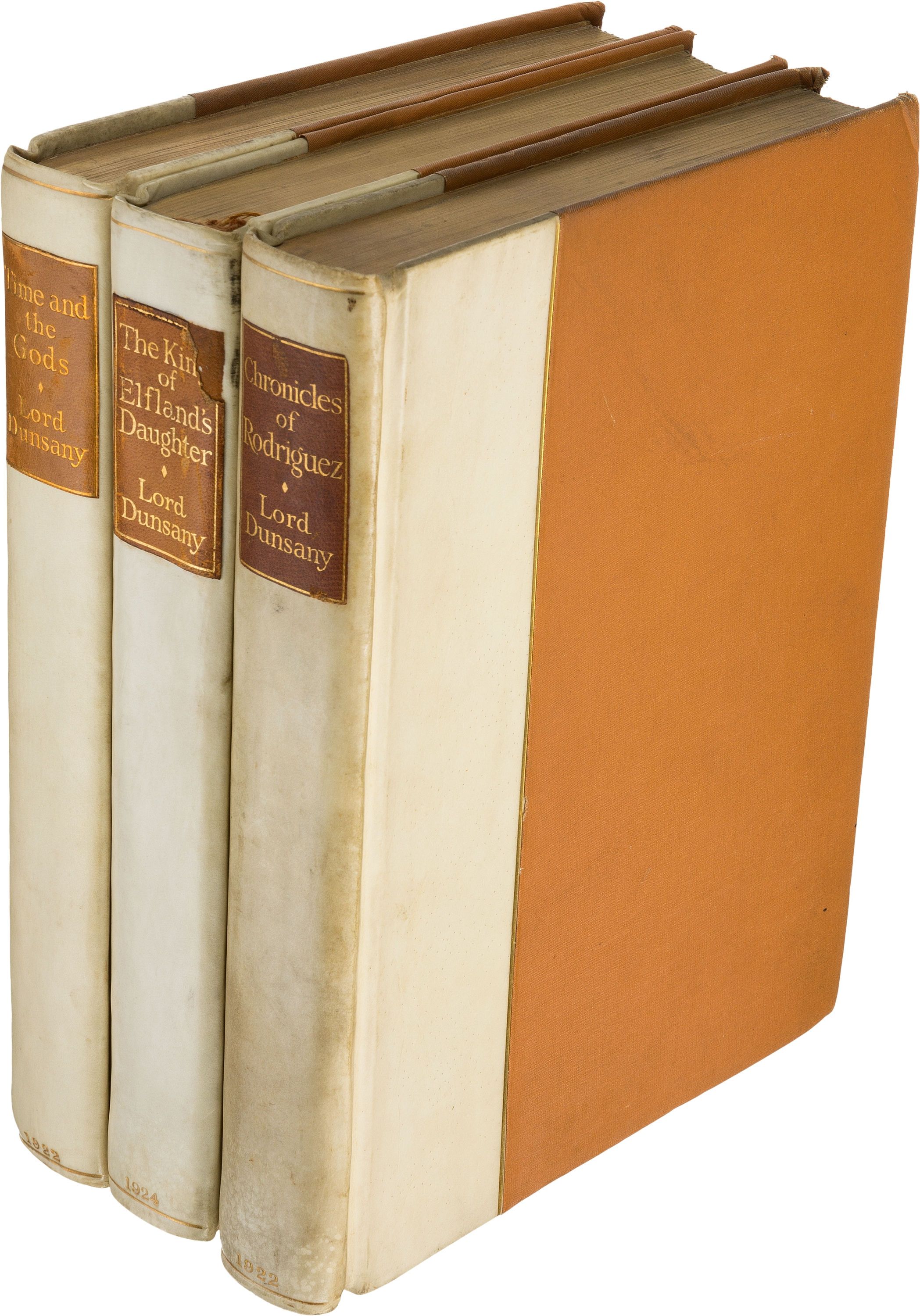
First there were the sumptuous oversized limited editions, signed by both Dunsany and Sime, of The Chronicles of Rodriguez (1922),  Time and the Gods (1923), and The King of Elfland's Daughter (1924). For these, Sime drew new emblematic illustrations for the fronts of the dust-wrappers. Here are each of the three.


[end of part one]

Monday, March 11, 2024

Dunsany on His Early Stories

In 1917, the John W. Luce Company of Boston published a "Gift Edition," a boxed edition of six volumes of his early stories. One set he inscribed (probably during his 1919 US tour), and it was put up for auction by Swann Galleries in 2011. Their catalog entry here shows the handwritten poem by Dunsany that he inscribed in The Gods of Pegana. I transcribe it here.

In a dream I must have gone,
  In a dream and sleeping fast, 
To a city never known,
  In a land that cannot last.

Thence these stories I have brought
  For your cities mad with steam,
That a dream from skies unthought
  May be mingled with your dream. 

Dunsany


Sunday, July 9, 2023

How to Correctly Pronounce Names Like Cabell, Dunsany, Machen, Powys and Tolkien

The Literary Digest was a weekly American magazine published by the Funk & Wagnalls Company of New York. It began in 1890, and by mid 1937 it was evidently stumbling, for in February 1938 it folded.  One of its editors in the 1930s had responsibility for a filler column called “What’s the Name, Please?” This editor, Charles Earle Funk, wrote to various prominent or up-and-coming people with names that could be easily mispronounced, asking them how their name should be pronounced. A number of the responses appeared in issues of The Literary Digest, and the column was reportedly popular. Funk decided to make a book of the responses, including names which were yet expected to appear in the future issues of The Literary Digest. The book was titled What’s the Name, Please? A Guide to the Correct Pronunciation of Current Prominent Names, published by Funk & Wagnalls Company in May 1936.  A second printing came out in June, but the overall sales were evidently small, for the book is rare today.

A number of writers of fantasy with easily mispronounced names appear in the book.  (I do not know if their notes ever appeared in The Literary Digest.) Here are the entries for James Branch Cabell, Lord Dunsany, Arthur Machen, John Cowper Powys, and J.R.R. Tolkien.  

I've written about the pronunciation of Cabell previously on this blog, here


Here's is Lady Dunsany's reply:


Arthur Machen's entry (which crosses over two pages) also includes notes on the American J. Gresham Machen, who had a different pronunciation of his last name:

John Cowper Powys's entry includes his brother Llewellyn Powys:

And it seems early for Tolkien (here, in the never-used form of "John R.R. Tolkien") to have appeared in such a formulation. When Funk's book was published in May 1936, Tolkien was six months from delivering his landmark British Academy lecture Beowulf: The Monsters and the Critics, and The Hobbit wouldn't be published in England until September 1937, and in the U.S. in March 1938.


Saturday, December 4, 2021

Poetic Elves in the 1920s

I was discussing "twee" with a friend and remembered a nifty poem I read about thirty-five years ago.  Of course I had to go find it, and it's as good as I recall, so I'll share it here.

How to Treat Elves

by Morris Bishop

I met an elf-man in the woods,
the wee-est little elf!
Sitting under a mushroom tall—
'twas taller than himself.

"How do you do, little elf," I said,
"and what do you do all day?"
"I dance 'n fwolic about," said he,
"'n scuttle about and play;

"I s'prise the butterflies, 'n when
a katydid I see,
'Katy didn't!' I say, and he
says 'Katy did!' to me!

"I hide behind my mushroom stalk
when Mister Mole comes froo,
'n only jus' to fwighten him
I jump out 'n say, 'Boo!'

"'N then I swing on a cobweb swing,
up in the air so high,
'N the cwickets chirp just to hear me sing,
'Upsy-daisy-die!'

"'N then I play with the baby chicks,
I call them, chick chick chick!
'N what do you think of that?" said he.
I said, "It makes me sick."

"It gives me sharp and shooting pains
to listen to such drool."
I lifted up my foot, and squashed
the God damn little fool. *

The poem first appeared in The Saturday Evening Post for 3 April 1926 (it was reprinted in an anthology edited by Thomas L. Masson, Laughs: A Sovereign Remedy for Boredom, published in November 1926). That makes it nearly contemporary with Lord Dunsany's poem, "Ode to a Dublin Critic," apparently first published in Fifty Poems (1929). Here are the first two stanzas (of five):

        Ode to a Dublin Critic
 
        Through steely gaps that I have known 
           In mirage mountains, upon wings 
        Has my imagination flown 
          To bring you news of magic things.

        And lesser journalists have said, 
          That cannot see such things themselves, 
        The man is clearly off his head 
          To write of things like gods and elves

Of course earlier in the same decade, J.R.R. Tolkien was writing of 'Tinfang Warble" in a fairy poem first published in 1927. It is a conception Tolkien would (thankfully) abandon.  Here are the first eight lines.

Tinfang Warble

O the hoot! O the hoot!
How he trillups on his flute!
O the hoot of Tinfang Warble!

Dancing all alone,
hopping on a stone, 
Flitting like a fan, 
In the twilight on the lawn, 
And his name is Tinfang Warble!


* The text of "How to Treat Elves" is that given in Bishop's collection Spilt Milk (1942). The poem also appears in Bishop's earlier collection Paramount Poems (1929), but I have not seen that appearance.

Sunday, March 14, 2021

Dunsany Himself on Film

The photograph of Dunsany reproduced at right comes from a magazine from 1950.  Dunsany looks, at age 72, a bit scruffier than in most other contemporary photos, with a longer and less-artfully trimmed beard.  But what is especially interesting to me is the caption, with the information that Dunsany is reading one of his Jorkens stories before the BBC television cameras. I know of audio recordings of Dunsany's voice (he occasionally read stories over the radio in the 1930s), and I wrote about one here. But the possibility that he was filmed reading a story is new to me. If anyone knows any further details about such things, please let us know via the comments. 

The only time (currently) that I know of when Dunsany was filmed was for a ten-minute segment of the long-running  BBC Television show "Speaking Personally," which ran from November 1936 through April 1964. Dunsany's segment was broadcast at 9 pm, on Tuesday, 7 June 1938. Likewise, I do not know whether it, or any filmed footage of Dunsany, still survives.


Wednesday, March 10, 2021

Dunsany's headstone

In perhaps the oddest scene of Digby Rumsden’s frustrating one-hour documentary on Lord Dunsany, Shooting for the Butler (2014), the filmmaker himself looks for Dunsany’s gravestone in grounds of the St. Peter and St. Paul Church in Shoreham, Kent. Unable to find it, he concludes that it is no longer there. But others have not only found it, but photographed it.

Mike Barrett (a Kent resident) wrote about visiting it in “Dunsany: The Final Resting Place” in The New York Review of Science Fiction for December 2008. He noted that “the unpretentious grave is easy to find.” In Roy Bateson’s The End: An Illustrated Guide to the Graves of Irish Writers (2004), there appears the below photograph. Bateson notes that he “found the grave almost immediately. Go up the path and stand in front of the church, The grave is about 30 paces to the left of the church and about four metres back towards the road.” 


 Both Barrett and Bateson transcribe the headstone:

IN
LOVING MEMORY OF
EDWARD JOHN MORETON DRAX
18TH LORD DUNSANY
DIED 25TH OCTOBER 1957
AGED 79 YEARS
'NATURE I LOVED AND NEXT TO NATURE ART'
BEATRICE, LADY DUNSANY
DIED 30TH MAY 1970
AGED 89 YEARS


Barrett identified the qute from Walter Savage Landor’s four-line poem, “Dying Speech of an Old Philsopher” (1849):

I strove with none; for none was worth my strife;
Nature I loved, and next to Nature, Art;
I warmed both hands before the fire of life;
It sinks, and I am ready to depart.

There is a poem (presumably by Lord Dunsany, but it has no known publication) on the plaque at the bottom, reading:

I, THAT HAVE LOVED THE SUN, LIE HERE, AND LOVED
THE GREAT GREY SHADOWS OF THE CLOUDS THAT PASS
OVER THE EARTH, THE SOFT CRISP ENGLISH AIR,
THE GREY SEPTEMBER DEW THICK ON THE GRASS.

I LOVED THE COOL STRANGE LIGHT THE RAINBOW GIVES,
THE DEEP NOTE OF THE BEES UP IN THE LIME,
THE SMELL OF HONEYSUCKLE & SWEET BRIAR,
AND THE HOT SCENT, UNDER MY FEET, OF THYME.

LATE SUNLIGHT SLANTING ON THE IRISH PLAIN,
THE LINE OF LOW BLUE HILLS AGAINST THE SKY
I LOVED WHILE SIGHT & MEMORY WERE MINE
OTHERS WILL LOVE THEM STILL WHILE HERE I LIE.