Showing posts with label S.H. Sime. Show all posts

Tuesday, August 20, 2024

Some Offtrail S.H. Sime illustrations for Lord Dunsany, Part 2 of 2

In the early 1920s, G.P. Putnam's Sons became Dunsany's publisher on both sides of the Atlantic. Most of the books had different dust-wrappers in each territory (and the US books were accordingly printed in the US). The London office utilized new art by Sidney H. Sime, first on the limited editions (discussed in Part 1of 2, see here).

Putnam's gradually acquired the rights to the collections of Dunsany's plays, as previously published by other publishers. And besides the hardcover collections, Putnams published acting editions in wrappers which had Sime illustrations on the covers. There are three different Sime covers.

The first shows Skarl the Drummer from The Gods of Pegana.

The second is a new Sime, a wrap-around illustration somewhat out of his normal style, but definitely Sime. 

 The third is Sime's Pegasus in the stars.

Sime's Pegasus reappeared on other Putnam's (London only) dust-wrappers, from The Charwoman's Shadow (1926) through The Travel Tales of Mr. Joseph Jorkens (1931), after which Putnam's New York ceased to be Dunsany's US publisher, and Putnam's London took on only two further titles, a poetry collection titled Mirage Water (1938), and the third collection of Jorkens stories, Jorkens Has A Large Whisky (1940), both of which had Pegasus on the dust-wrapper. (Putnam's did not published the second collection, Jorkens Remembers Africa, 1934.) 

image John W. Knott


Sime's final illustration for Dunsany while at Putnam's was the frontispiece for The Blessing of Pan (1927).

Sime produced his final illustration for Dunsany as the frontispiece of the Heinemann edition of My Talks with Dean Spanley (1936).



Saturday, July 27, 2024

Some Offtrail S.H. Sime illustrations for Lord Dunsany, Part 1 of 2

S.H. Sime's full-page illustrations for the books of Lord Dunsany run from The Gods of Pegana (1905) through My Talks with Dean Spanley (1936), some of which were produced in glorious photogravure. But in the 1920s, after Dunsany had secured G.P. Putnam's Sons as his publisher on both sides of the Atlantic, the London office celebrated Sime's work in ways no previous publisher of Dunsany's had. 

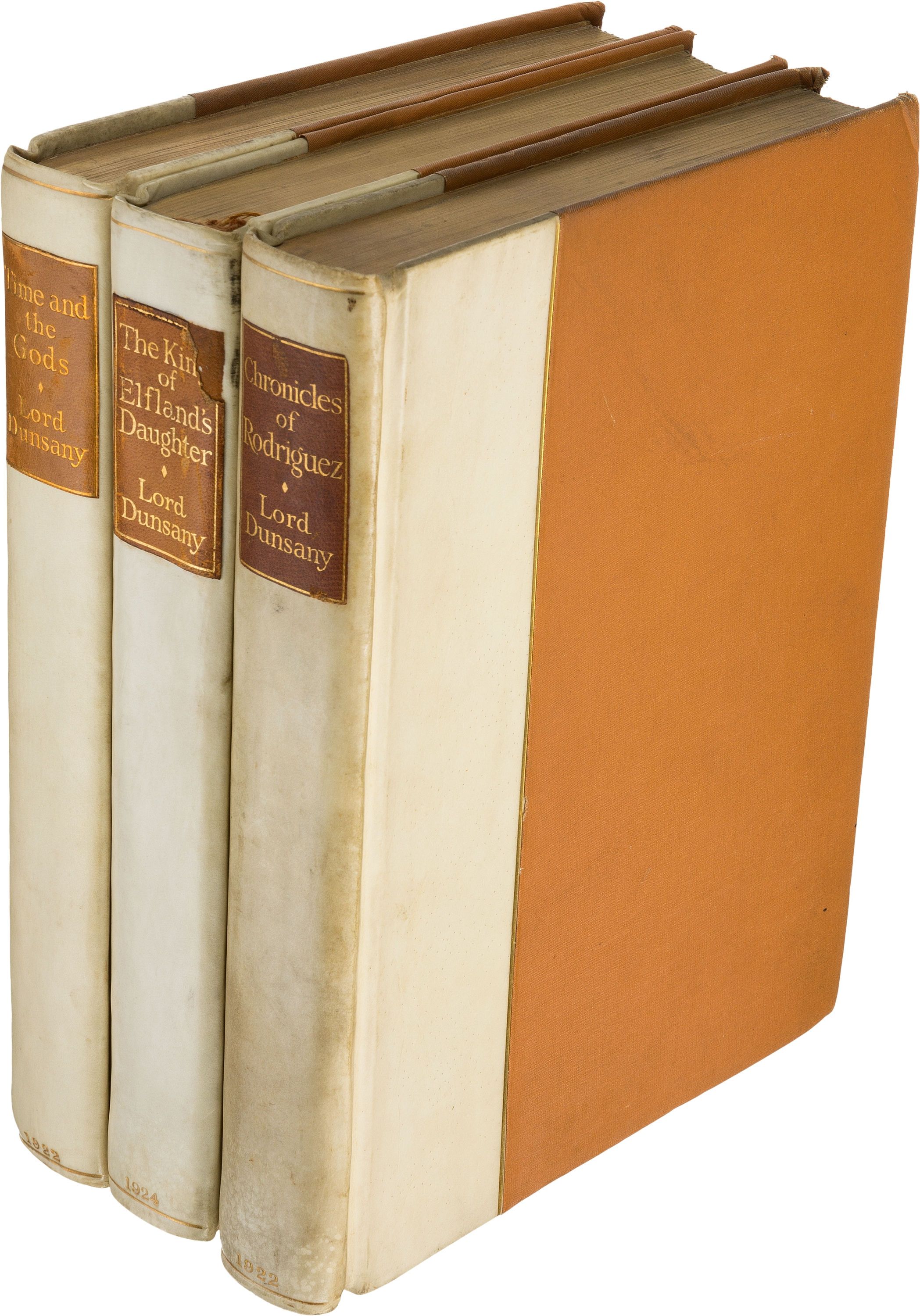
First there were the sumptuous oversized limited editions, signed by both Dunsany and Sime, of The Chronicles of Rodriguez (1922),  Time and the Gods (1923), and The King of Elfland's Daughter (1924). For these, Sime drew new emblematic illustrations for the fronts of the dust-wrappers. Here are each of the three.


[end of part one]

Monday, March 18, 2019

Sime in 1910

A nice photograph (by E.O. Hoppé) of S.H. Sime appeared in The Sketch for 28 December 1910. The demonic face, with lighted eyes, peering down at Sime is a nice touch, but what is Sime holding in his hands?  It looks perhaps like a figurine of a couple embracing, but I'm not sure.  Any thoughts? 


A close-up of Sime's hands

Wednesday, March 13, 2019

A Lost Sime Illustration for Dunsany's Book of Wonder

Dunsany's Book of Wonder was published by William Heinemann in November 1912.  It contains fourteen tales, twelve of which originally appeared in a different order (and with texts abridged) in The Sketch between December 1910 and March 1911. The book reprints ten illustrations by S.H. Sime, while the serialization had eleven illustrations.  The Sime illustration in the periodical but not in the book was for the story "The Injudicious Prayers of Pombo the Idolator." I copy it below (click on it to see a larger version).  One wonders if it might have seemed too dark to print in the smaller book-sized format.


If you zoom in you can see what I presume to be the high-priest of Maharrion ("who is neither bird nor cat") to the left of the center, and to the right of it a boy (Pombo?) before "the little idol Duth." I suspect the figure (?) to the left of the base of the stairs is Maharrion "the god of flowers" and the aureoled growth hanging out over the abyss is supposed to be some kind of unearthly flower. Of course for The Book of Wonder, Dunsany and Sime reversed their usual process, and Sime made the illustrations first, and Dunsany then made up stories to fit the illustrations. 

Friday, January 1, 2016

Lord Dunsany on THE KING OF ELFLAND'S DAUGHTER

The American dust-wrapper from 1928

Dust-wrappers are occasionally the source of interesting comments by authors on their own works.  Recently I acquired a copy of the first American edition of Dunsany's novel The Blessing of Pan, published by G.P. Putnam's Sons in January 1928.  (The British edition had been published by the London office of G.P. Putnam's Sons in September 1927.  It has a different dust-wrapper: see below.)

The Blessing of Pan was Dunsany's first novel written after The Charwoman's Shadow (1926), which was preceded by The King of Elfland's Daughter (1924). And on the rear of the American dust-wrapper of The Blessing of Pan (but not on the British dust-wrapper) is a nice quote from Dunsany himself about his now classic novel. So far as I know this quote appears nowhere else. It reads as follows:

THE KING OF ELFLAND'S DAUGHTER

Of this novel, Lord Dunsany writes:

"My Tale concerns some people living about a thousand years ago, in a perfectly ordinary village in a quite ordinary land, only not far from them, little more than one hard day's walk, lies the border of Elfland. Determining that their village and valley, which they love, should at last become well-known among other lands, they took too much interest in magic. Their traffic with Elfland brings their village that touch of mystery which they think will make it as famous as they had planned. It grows more and more magical and gets quite beyond their plans. And one day Elfland moves and passes over the village, leaving them to dream in the eternal calm of Elfland; but their village passes out of all human remembrance." 

 This tale was written, much of it, at Lord Dunsany's Castle in Ireland, the home of elves and leprechauns, and much of their quality has found its way into the pages of his book. The story is filled with all the gorgeous trappings of a super-fairy tale . . .  enchanted swords,and magic tunes, trolls and unicorns, kings and witches, a great hunter and a Princess.
The 1927 London dust-wrapper

The novel is dedicated to artist S.H. Sime, who did the Pegasus illustration on the London dust-wrapper (above), as well as a fine frontispiece (below) which appears in both editions.

Frontispiece by Sidney Sime