Sunday, March 20, 2016

New Evidence on the Posthumous Editing of Robert E. Howard’s ALMURIC


In the April 1939 issue of Weird Tales, under the heading “Coming Next Month,” there was an announcement by editor Farnsworth Wright of the forthcoming publication of a new story by Robert E. Howard, who had killed himself nearly three years earlier.  It reads, in part:
Weird Tales, April 1939 blurb
Robert E. Howard, at the time of his tragic death, was working on a new novel for Weird Tales. He had completed a rough first draft, and nearly completed a revision which was to be his final version. . . .  So engrossing is this story, Almuric, that Weird Tales would not be playing fair with you, the readers, if we did not let you see it. Therefore we have pieced together the nearly completed final draft that Howard wrote with the final pages of Howard’s rough first draft, which contains a smashing denouement.  (page 152)

This statement leaves open several questions. Who did the editing?  Why?  And what precisely was done to Howard’s texts? 

The two manuscripts of Almuric—like those of all of Howard’s contributions to Weird Tales—do not survive.  The mysterious situation of Almuric has been explored by a number of Howard scholars, and the consensus opinion seems to be that expressed by Mark Finn in his Blood & Thunder: The Life and Art of Robert E. Howard (updated and expanded second edition, 2011), when he writes of Almuric that it was “unfinished when Robert was alive and most likely completed by legendary pulp writer and friend of Otis Kline [Howard’s agent], Otto Binder” (page 379). The argument leading to this conclusion was made by Morgan Holmes in his invaluable article, “The First Posthumous Collaborator,” published in the final issue (December 2008) of The Cimmerian (pages 17-24).

Holmes makes many significant points—that Wright is probably guilty of editorial fabrication when claiming that Almuric was being written for Weird Tales (according to Holmes’s analysis it probably dates to early 1934, two years before Howard’s death); and that  the ending seems “almost criminally anti-Howardian” and that it exhibits “a sudden sea-change of style and theme of a sort unique in all of Howard’s work—the last chapter blithely undoes it all, giving us a finale filled with peace, brotherhood, and eternal friendship among formerly fierce, barbaric enemies” (page 17).  Holmes argues that the person who edited the text was unlikely to be either Farnsworth Wright (perhaps due to advancing Parkinson’s), or Otis Adelbert Kline (who took only a ten percent commission as agent, and not the fifty percent commission he would have taken had he done the job), and considers some other authors, settling at last on Kline’s friend, Otto Binder, primarily for stylistic reasons. 

The recent discovery of a typed letter settles the question of who, and some of the reasons for  why. In brief, it was Farnsworth Wright who did the editing.  On January 4, 1939, Wright wrote to Sam Moskowitz, giving information on future stories in Weird Tales, noting:

Beginning in the May issue, we are printing a posthumous interplanetary novel by Robert E. Howard, entitled “Almuric.” At the time of his death, Mr. Howard had completed a first draft of the story, and had done the greater part of the second draft. The novel is so striking that I thought it would be unfair to our readers if we did not give them a chance to read this. So I pieced together an ending from the first draft and used it to complete the second draft to make a complete story.

So there we have it. Who?  Farnsworth Wright.  Why?  Ostensibly to share the story, which Wright apparently admired, with the Weird Tales readership, but doubtless also to be able to parade Robert E. Howard’s name and writing in the magazine once more.

What precisely Wright did to Howard’s text will likely never be known.  Howard often wrote multiple drafts of his stories, so the idea of a second draft being a final draft is not necessarily true.  Howard seems to have abandoned the story himself, for whatever reasons, and moved on to other things.  One aspect of the ending (the strong-man-gets-the-pretty-girl) is at least foreshadowed throughout the text as published.  Almuric as a story is somewhat indebted to the works of Edgar Rice Burroughs, and such an ending is not unlike what is found in Burroughs (and also found in the pastiches of Burroughs by Howard’s agent, Otis Adelbert Kline). Perhaps Howard originally wrote such an ending in his rough first draft, and as he worked on his second draft he could not see his way to a more typical Howardian ending, and thus the story was abandoned. 

The easy solution would be to blame the editor for the ending, as Holmes does primarily on stylistic points, but there is no actual evidence that Wright wrote or tampered much with the text.  By Wright’s own words there was a complete first draft, and a “nearly completed” (per the note in Weird Tales) second draft, or one with “the greater part” (per Wright’s letter to Moskowitz) of the second draft being written.  In both sources Wright states that he “pieced together” an ending from the first draft to complete the second draft. On the other hand, Holmes’s stylistic analysis of the final chapter is cogent and persuasive. Unfortunately the facts of whatever actually happened in the editing process are apparently lost to history. 

Thursday, March 10, 2016

With Hide So Tough . . .

A few months ago I came across an interesting quotation:
Breathes there a man with hide so tough
Who says two sexes aren't enough?
It was attributed to one one Samuel Hoffenstein (1890-1947), whom I discovered to be remembered primarily as a screenwriter, having worked on the scripts for many movies, some credited to him like Dr. Jekyll and Mr. Hyde (1931, directed by Rouben Mamoulian) and Phantom of the Opera (1943), others uncredited, like The Wizard of Oz (1939).

I came to this quotation in some commentary on a Clifford Simak short story, "Mirage"  (variant title "Seven Came Back"), first published in Amazing in October 1950, because Simak's story concerns a race of aliens with seven sexes. I wondered whether the poem from which these lines came might be more interesting in full context.  Alas, that is not true.

Dorothy Parker approved; over 100,000 copies sold
The couplet is a complete poem in itself, number III. in a series of "Love-Songs, at Once Tender and Informative--An Unusual Combination in Verses of This Character," which is a section comprising some twenty-three poems in Hoffenstein's collection, Poems in Praise of Practically Nothing (New York:  Boni & Liveright, 1928), which went through a number of printings and editions. I can't see why the book was successful, as the poetry is quite tedious and there is a lot of it.  The first stanza of the opening "Proem" gives a fair sample:

How exquisite my sorrows look
Neatly marshalled in a book,
Hung on the iambic line
In an orderly design! 

I was not inspired to read further, so I cannot say whether Samuel Hoffenstein deserves to be remembered alongside of John William Burgon as a poet who is remembered for only a short line or two.  Burgon (1813-1888) won the Newdigate Prize at Oxford in 1845 for his poem Petra, which described the place of the title in an immortal line as "a rose-red city half as old as time."  (There is nothing else remotely interesting in the poem Petra, which I read years ago.  Burgon even lifted part of his line "half as old as time" from an earlier poet, Samuel Rogers.) 


Wednesday, March 2, 2016

"We Care" --Hah!

This happened last year, but I just happened on the photographs I'd saved so I thought I'd share them here.  Most of the stuff I send through the U.S. Postal Service, or the stuff that gets sent to me, comes through fine, but occasionally there comes one of those obnoxious "We Care" bags (see below), with the packaging or contents damaged (to varying degrees) in transit.  This issue of VII seems to have had deliberate malice practiced upon it. My mind can't conceive what was done to the package to cause this sort of damage. I couldn't even open the pages.


Sunday, February 28, 2016

All the Wonders We Seek: Some Bibliographical Notes


Félix Martí-Ibáñez's collection All the Wonders We Seek: Thirteen Tales of Surprise and Prodigy was published by Clarkson N. Potter in November 1963.  It includes two stories published in the last years of the initial run of Weird Tales ("Between Two Dreams" May 1953; and "A Tomb at Malacor" in the final issue, September 1954).  The collection itself is excellent, and like many fantasy collections, best savored a few stories at a time rather than devoured in one sitting. 

For years I've had two copies, one on much thicker paper than the other, but otherwise identical, save for the the fact that on the upper front flap of the dust-wrapper of the thinner book, there is a statement denoting it is the second printing, a fact that is not indicated on the copyright page, where no statement of printing is present, as with the thicker version.
Second printing at right
The front flaps
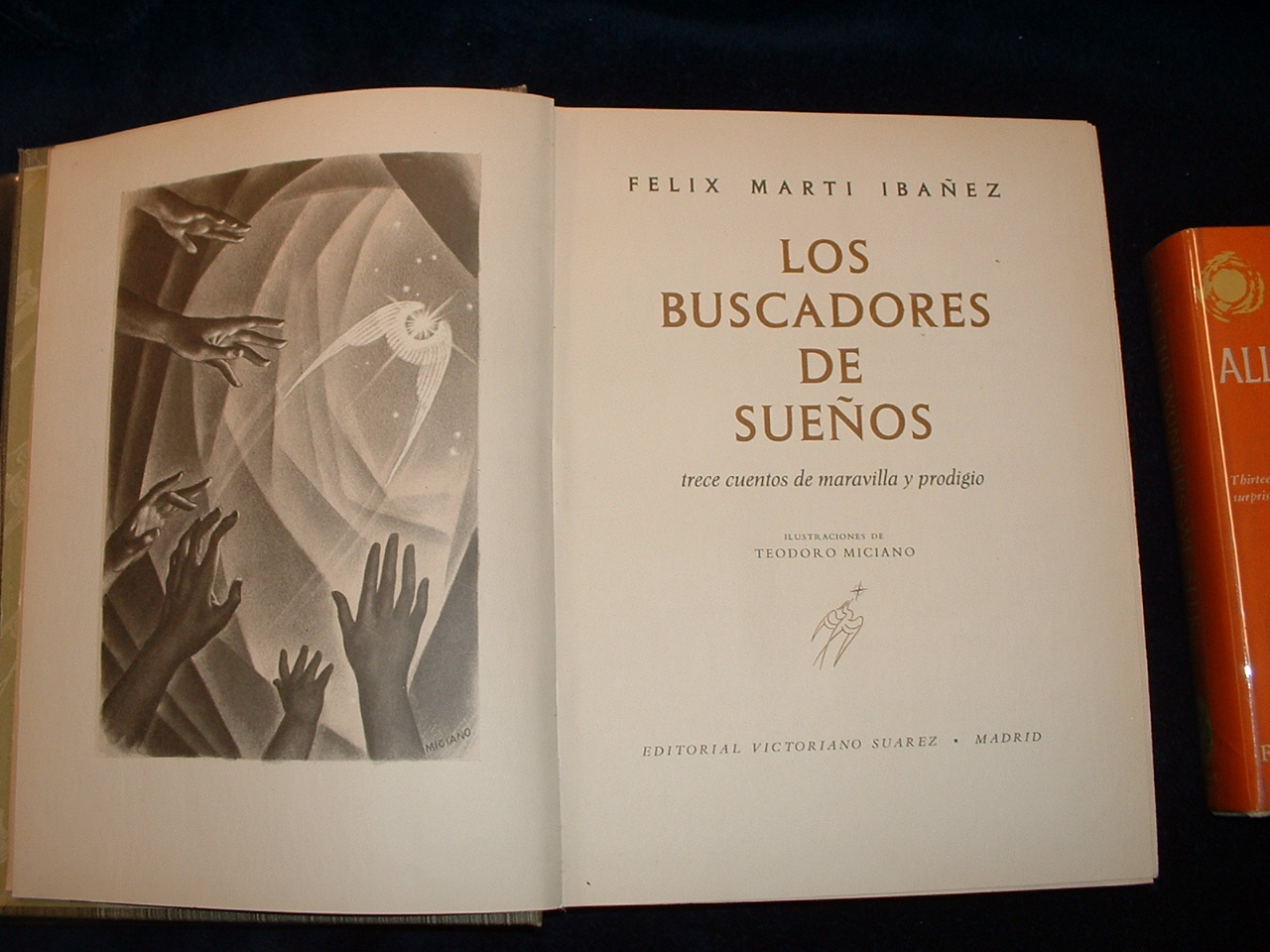
What is less-known is that in 1964 Martí-Ibáñez published an large format edition in his native Spanish, with illustrations by Teodoro Miciano. Retitled Los Buscadores des Sueños: Trece cuentos de maravilla and prodigio  [The Seekers of Dreams: Thirteen Tales of Wonder and Prodigy], it stands tall next to its English counterparts. 


Martí-Ibáñez published another collection of his short stories in English in 1965, Waltz and Other Stories, but here the magic is mostly absent, and this volume is a complete and disappointing contrast to the earlier collection. 

Sunday, February 14, 2016

Best College Verse, with a dash of Lovecraftians

The beginning of the Depression was not the best time to launch a new series collecting the best verse by college students. Yet Harper & Brothers did that, with Best College Verse 1931, edited by Jessie Rehder, with a preface by Christopher Morley, clocking in at over 320 pages.  There were no subsequent volumes, and I don't know how well (or how poorly) this volume did sales-wise, but contents-wise, it is remarkable in a number of ways.  There are as expected a lot of unrecognizable contributors, but some poems are by writers later to be famous, like Loren Eiseley, or by the children of writers who were already famous, like Christopher Gerould (son of Katharine Fullerton Gerould). I found it interesting to count three poets who were (or were soon to be) associated with H.P. Lovecraft. 

Pre-eminently there is Donald Wandrei, of the University of Minnesota, who contributed "Lyric of Doubt," a poems of four stanzas.  The first and last stanzas reads:

 She walks with stately grace.
  Her grave, gray eyes with beauty hide
    That has no counterpart in lands of time
Of space;
  And in her movements, languid charms abide. . . .
She walks with dust and dreams.
   All else is still the realm around,
      And she alone has beauty, grave and gay,
She seems
   A phantom of a kingdom of no sound.
Richard Ely Morse, of Amherst College and a correspondent of Lovecraft's, contributed two verses,both with macabre touches, but I here give only one of the poems, complete:

Down in the Orchard

"Down in the orchard
the grasses creep,
covering a grave
dug fair and deep.

"Down in the orchard
where nobody goes,
earth is over him
heard and toes.

"And nobody cares,
and nobody weeps,
for that bitter secret
the orchard keeps.

"While I sit safe
in a fire-lit room,
outside the wind
is cold as doom.

"Once to bed early
two filled with hate;
now I alone sit
when the hour is late,

"He cannot hurt me
any more,
he can only stare
at the worms that bore.

"A step upstairs, right over my head!
Who walks so late
When all are abed?

"The stairs go creak,
and the door goes crack;—
who is that standing 
at my back?

"I dare not move, 
nor turn to see,
lest he should be staring
there at me. 

"But I am drawn
in a close embrace
by arms as thin
and white as lace;

"Arms that are more
bone than flesh—
my hair is over me
like a mesh;

"Golden and silken,
a shining coat;
closely it tightens
round my throat! . . . "

Down in the orchard
the grasses creep,
covering two graves
dug fair and deep.
Morse published one collection of verse, Winter Garden (1931), but this collection does not include "Down in the Orchard." 

The final poet with a Lovecraft association is Winfield Scott, of Brown University, better knows as Winfield Townley Scott, who though he did not know Lovecraft himself penned a perceptive account of him "His Own Most Fantastic Creation" which appeared in Marginalia (1944), edited by August Derleth and published by Arkham House.  Scott contributed three somewhat cosmic and slightly macabre poems to Best College Verse 1931 Here is one:

The Last Man

Slowly and painfully and all alone
He climbs the hill to watch the setting sun;
Sickly and pale and cold as ancient stone
Its final light on this remaining one. 
He watches it; where clouds were thick with rain
A rainbow glimmers—God's last mockery;
He hears below the dim edge of the plain,
Far off, the gradual stilling of the sea. 

Standing there, bowed before the thin green light,
He looks down were so many million souls
Set banners flying and went beating drums
And tended fires and sped abroad to fight,
All—all for causes over which dust rolls. 
The sun goes out, and the great darkness comes.

Strangely, I had expected to find some contributions herein by the prolific writer and poet August Derleth, then at college, but nothing by Derleth appears in the volume.

Monday, February 1, 2016

Vincent Price Reads Lord Dunsany

The top half of the album (the whole is too big for my scanner)
I just pulled out an old Caedmon record to listen to Vincent Price reading four short stories by Lord Dunsany, two from The Book of Wonder ("Chu-Bu and Sheemish" and "The Hoard of the Gibbelins"), and two Jorkens tales ("The Club Secretary" from Jorkens Remembers Africa; and "Making Fine Weather" from The Fourth Book of Jorkens).  Price does a pretty good job, letting the stories themselves entertain, without any hamming it up by the performer. 

The LP was released in 1982, in that far-distant time before CDs and MP3s, etc. The liner notes are by L. Sprague de Camp, who when he isn't being too bombastic about himself, can be rather keen as an observer of others.  Yet while de Camp certainly met Lady Dunsany in 1963 and again in 1967, he didn't meet Dunsany himself. Still his capsule description of Dunsany in the liner notes, rings true, perhaps reflecting the views of Lady Dunsany:

He was six feet four inches tall and sometimes called the worst-dressed man in Ireland. He was a writer, poet, playwright, lecturer, soldier, sportsman, country squire and world traveler all rolled into one. When not roaming the world, hunting foxes in the British Isles or wild goats in the Sahara, serving as a British officer in the Boer and First World wars, being wounded in the Easter Rebellion in Ireland, and making an abortive entry into politics, Dunsany found time to write sixty-odd books of stories, plays, essays, verse, and autobiography, How he accomplished all this with a quill pen we shall never know; he never revised or rewrote. An enthusiast for games and sports, from chess to lion hunting, he was at various times the chess and pistol champion of Ireland. 

A man of fiery temperament and poetical sensitivity, Dunsany was torn by the conflict between his background and upbringing, that of a conventional hunting-shooting-fishing-and-soldiering Anglo-Irish peer, and his personal literary tastes and interests. A garrulous, fun-loving, sociable man, he was esteemed by those who liked him as genial, delightful, and fascinating. But no man of such strong personality is liked by all. Those who did not like Dunsany found him  arrogant, opinionated, self-centered, and sometimes testy and inconsiderate. He had strong opinions on many subjects. He denounced the turgid free verse of most contemporary poets and "bells of lead" and dismissed T.S. Eliot's work as "frightful nonsense."